
Living-Room Wall Murals: Layouts That Work Around Sofas and Screens
Plan a living room wall mural layout around your sofa, TV and seating: focal points, quiet screen zones, compositions and survey prep for Saudi homes.
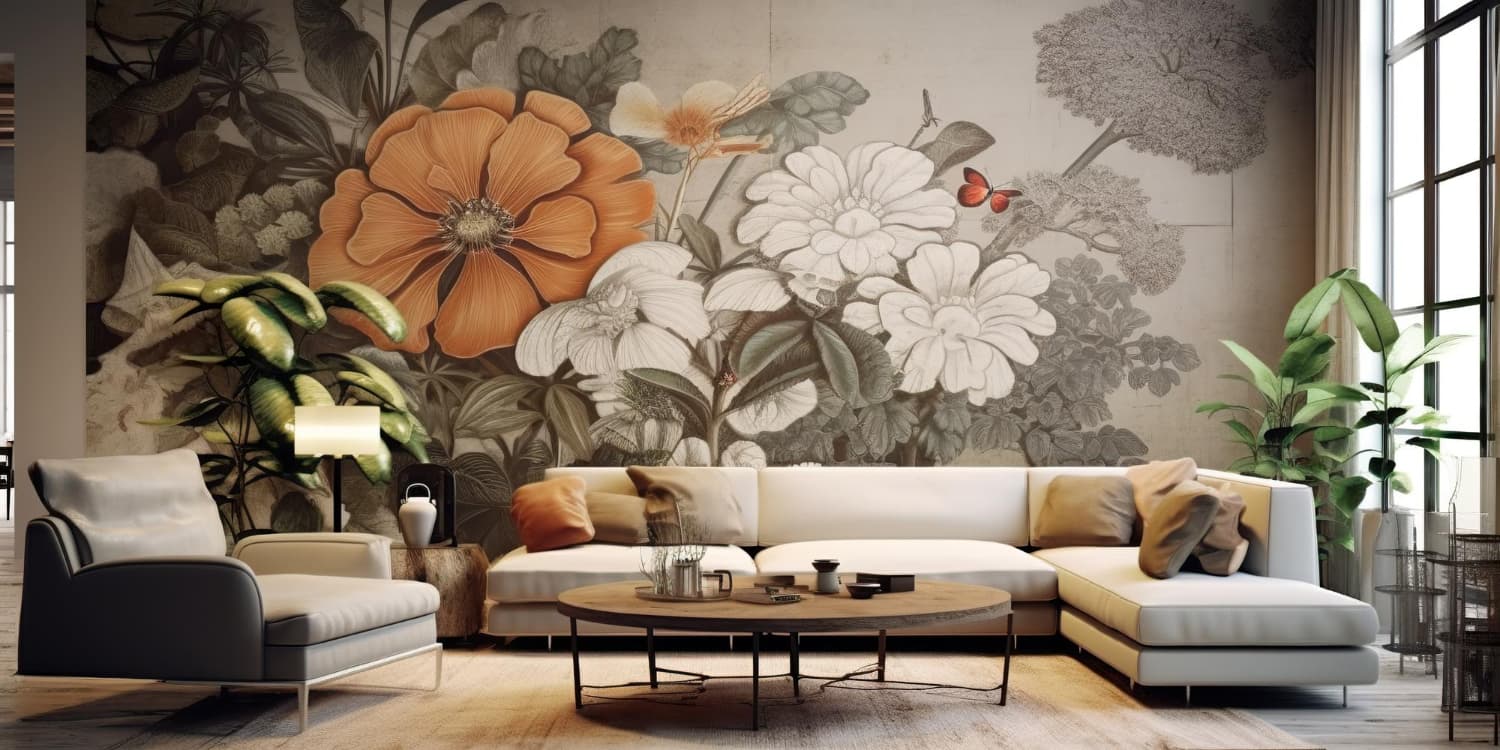
A good living room wall mural layout starts with the furniture, not the artwork. Fix the sofa line, the screen position and the main viewing seat first, then place the mural's focal point where it will not compete with the TV or disappear behind cushions. In most Saudi living rooms that means designing above the sofa back.
This guide shows how to plan a printed mural around the three things that shape almost every living room in Riyadh and Jeddah: the sofa, the screen and the way people move through the space. It is about composition and placement, not about which printing method to choose.
Why Does Layout Matter More Than the Artwork?
A strong design can still fail if it is laid out without the room in mind. The most common problems are easy to predict: the main subject of the mural sits exactly where the sofa back hides it, a busy pattern runs behind the TV and fights with the picture, or the strongest colour lands on a wall that nobody faces when seated.
Layout decides what people actually see from where they sit. Before anyone looks at colours or themes, the wall should be mapped into zones: the area hidden by furniture, the area at seated eye level, the area above that, and any space taken by the screen, shelves or air-conditioning units. If you have not yet chosen which wall should carry the mural, start with our guide to choosing the right wall for a printed mural, then come back to plan the layout.
How Should a Mural Work Behind a Sofa?
The sofa wall is the most common choice for a living room wall mural layout because it faces the room and is seen by everyone who enters. The key is to treat the sofa back as a horizon line.
Keep the focal point above the sofa back
Anything below the top of the backrest will be hidden for most of the day. Keep faces, calligraphy, horizons and other details people should notice above that line. The lower band can carry continuous texture, colour or a soft gradient that still looks complete when cushions cover parts of it.
Match the mural's width to the furniture group
A mural that is much narrower than the sofa can look like an afterthought, while one that runs wall to wall can overwhelm a small room. A practical approach is to centre the main composition on the sofa and let the design fade or simplify towards the edges, so it reads as one group with the seating.
Plan for wall lights and frames
If you intend to add sconces, a shelf or framed pieces later, mark them on the wall plan now. A mural designed with gaps for these elements looks intentional; one that is covered afterwards often looks cluttered.
How Do You Design a Mural Around a TV Screen?
Printing around a TV is possible, but the screen should stay the main focus when it is on. The mural's job is to frame it calmly, not compete with it.
- Use a quiet zone around the screen: keep the area immediately around the TV low in contrast and detail, so the eye is not pulled away from the picture.
- Avoid strong lines that cut through the screen: a horizon or architectural line running behind the TV at the wrong height can look broken. Align strong lines with the top or bottom edge of the screen, or keep them away from it.
- Think about glare and reflections: very light or bright areas opposite a window can increase reflections on a glossy screen. Darker or mid-tone areas around the TV usually feel more comfortable in the evening.
- Leave room for cables and brackets: confirm the TV size, mount position and any cable channels before the design is finalised, because moving the screen later can expose a gap in the artwork.
A common rule of thumb in home-cinema guidance is to mount the screen so its centre sits roughly at seated eye level. If that is your plan, mark the screen outline on the wall at the survey stage so the designer can build the composition around it.
Which Composition Fits Your Living Room?
Most successful layouts follow one of a few simple compositions. Choose based on how the room is used, not only on style.
- Centred panel above the sofa: best for formal rooms and symmetrical seating; can feel small if the wall is very wide.
- Full-wall landscape with a low horizon: best for large family rooms and double-height walls; watch for details hidden by tall sofa backs.
- Off-centre focal point with negative space: best for modern rooms and walls with a window or door; needs careful balance with furniture weight.
- Framed TV wall with quiet surround: best where the screen is the main feature; avoid busy patterns near the screen.
- Wrap-around design across a corner: best for L-shaped seating and open-plan spaces; can break at the corner if not planned on site.
How Do Viewing Distance and Eye Level Change the Design?
People experience a living room mural mostly while seated, so design for that view first. Fine detail works when the main seat is close to the wall; from across a large majlis-style living room, bolder shapes and clearer contrast read better.
Stand where guests will enter and sit where the family usually watches TV. Note what you see in each position, and ask the design team to show a mock-up from both viewpoints. Our article on choosing artwork style, size and quality for wall printing explains how scale and resolution affect what reads clearly at different distances.
How Much Negative Space Should You Leave?
Negative space is the calm, less detailed part of a design. In a living room it gives the eye a place to rest and stops the mural from feeling crowded once furniture, lamps and the TV are in place.
As a general guide, the busier the room, the more negative space the mural needs. A room with patterned rugs, heavy curtains and a large sectional sofa usually benefits from a simpler design with one clear focal area. A minimal room with plain furniture can carry more detail across the wall.
What Should You Prepare Before the Site Survey?
A clear brief shortens the design stage and reduces revisions. Before the survey, gather:
- Photos of the wall from the entrance and from the main seat, with the furniture in place.
- Approximate wall dimensions and the height of the sofa back.
- The TV size and planned mounting position, if the screen is on the same wall.
- Locations of sockets, switches, air-conditioning units and curtain tracks.
- Two or three reference images showing the mood and colours you like.
- Any family preferences, such as calligraphy, landscapes or geometric patterns.
For a wider view of how residential projects run from brief to handover, see our residential wall printing planning guide for homes and villas.
Common Living Room Wall Mural Layout Mistakes
- Placing the main subject behind the sofa back or a tall headboard-style cushion.
- Running a busy or high-contrast pattern directly behind the TV.
- Choosing the design before confirming furniture positions and screen size.
- Ignoring how evening lighting changes colours on the wall.
- Filling every part of the wall, leaving no space for the room to breathe.
Frequently Asked Questions
Should a living room mural go behind the sofa or the TV?
Either can work. Behind the sofa is usually easier because the mural becomes the room's focal point without competing with a screen. Behind the TV works if the area around the screen is kept calm and low in detail. The right choice depends on which wall people face most and how the room is used day to day.
How high should the main part of a sofa wall mural start?
Keep the important details above the top of the sofa back, because anything lower will be hidden most of the time. The lower band can carry colour or texture that still looks complete when partly covered. Measure the backrest height during the survey so the designer can set the composition from that line.
Can a mural be printed around a wall-mounted TV?
Yes, as long as the screen size, mounting height and cable routes are confirmed before the design is finalised. The safest layouts keep a quiet, mid-tone zone around the screen and avoid strong lines that cut through it, so the picture stays the focus when the TV is on.
Do large living rooms need a different mural layout?
Usually, yes. In large rooms people see the mural from further away, so bold shapes, clear contrast and a defined focal area read better than fine detail. A full-wall landscape or a wrap-around design can suit open-plan spaces, provided furniture and walkways are mapped first.
What should I send WallInks before a living room survey?
Send photos of the wall from the entrance and the main seat, rough dimensions, the sofa back height, the TV size and position, and the locations of sockets and air-conditioning units. Add a few reference images of styles you like. This helps the team prepare layout options and a more accurate scope.
Conclusion
A living room mural succeeds when its layout respects how the room is used. Map the sofa line, the screen and the main viewpoints first, keep focal details above the furniture, give the TV a calm surround, and leave enough negative space for the room to breathe. Choose a composition that suits your seating, then refine the artwork within that frame.
Ready to plan a printed wall that works with your sofa and screen? Share your living room photos and dimensions with WallInks to start your design brief.